
By: Ava Folcarelli
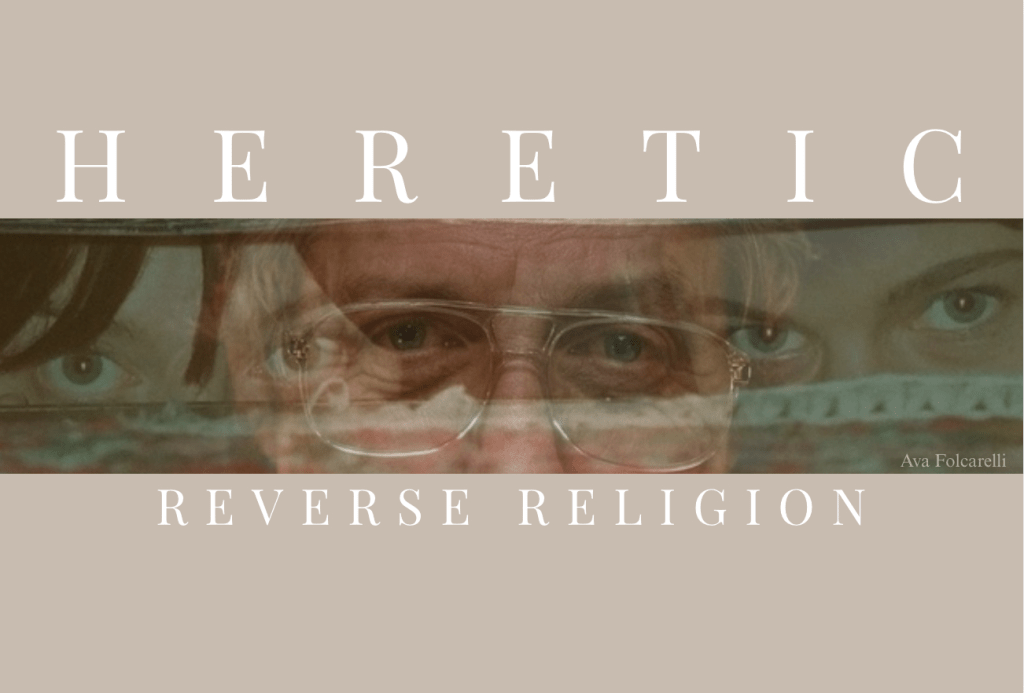
As we know, controversy has surrounded religion, specifically Christianity, for decades. Yet, in the year 2025, it has become a prevalent topic of discussion through the media as well as in film. As the toxicity of Christianity makes its debut on television, from experience to paper, its controversy can be dissected further through its parallels between Hollywood, the media, and reality. With ambiguity surrounding a true religion, I present the film Heretic, a conduit for religious mockery. Tieing personal experience to the outstanding truths in the film, I ask: How powerful is the mixed media we are fed, overall inhibiting our ability to establish truth?
Heretic: What the Film is About
Heretic explores the concept of religion through the lens of its antagonist, Mr. Reed: a religion connoisseur, if you will. Throughout the film, Mr.Reed conducts a test on the main characters, followers of the Church of Jesus Christ of Latter-day Saints. Reed takes pride in exposing the two girls to the contradictions of each religion, preaching his beliefs, and ‘turning the tables’ if you will. To put it simply, he highlights the eerie similarities among religions, effectively undermining their claim to originality and truth. Other sources have gone further in explaining his manipulation, as Thompson writes, “Mr. Reed’s speech dives into organized religion’s recurrent patterns, which he interprets as undermining their uniqueness and truth.” With this, it is essential to note that the entirety of the film is fictional; however, that is not to say the movie does not contain profound truths in its themes and connections to various religious views, specifically regarding Christianity.
My experience with Religion, on Paper: The Jehovah’ s Witness Community
To put into perspective the contradictions religion offers, as does the film, I offer my personal experience with being in attendance at the Memorial of Remembrance of Jesus Christ. The memorial I attended revolves around the scripture Luke 22:19, in which Jesus instructed his followers, after his death, to “Keep doing this in remembrance of me,” the breaking of bread and giving thanks in return for his “selfless death.” It is a common thought within the Jehovah’s Witness community that Jesus gave his life so all of mankind could live. It is through prayer, seeing the world through God’s eyes (hence the term “witness”), and obeying His rules that the Jehovah’s Witnesses have a chance to have “the opportunity for everlasting life.” Therefore, Jesus’s sacrifice, through a “painful, degrading death,” creates debts to be paid — debts that cost one’s remembrance and prayer and “living life to one’s best ability,” in return for hope that one will receive everlasting life; this was stated quite clearly in the sermon as “the obedience of a man.” To summarize my experience, the demands imposed on the Witnesses were based on guilt-tripping, which seemed to be a foundation built on fabricated rules, essentially a means for man to exert control over those who are willing in society. Though it is important to note that these practices of the Jehovah’s Witnesses have been around for a few centuries, it is equally important to note the everlasting effects these practices have on society, especially today. What is preached as truth is further contradicted in the media, disguising itself as mockery, but ultimately inhibiting the realization of the underlying reality.

Stopping Faith
No amount of convincing can stop one’s faith, rightfully so. Heretic, aside from the games of manipulation, also delves into the dedication the two girls have to their faith. At a point in the film, Sophie, one of the girls, despite being a firm believer, admits to knowing that there is no evidence to suggest that praying for a person’s healing results in a quicker recovery than for someone who was not prayed for. Still, she chooses to pray as that is what she believes is right and good. From here, I ask, does this make non-believers “wrong” or “bad people”? The film certainly portrays the main character, Mr. Reed, as evil and psychotic for challenging their theories, but is that not what the girls are doing by calling upon “interested” converts? Religion, as we know, is used to control the majority of society, setting rules for people to abide by, essentially for the sole power of a being; for no one even knows if he ever existed. As the Jehovah’s Witness community invites all to attend the Remembrance Memorial, Mr.Reed invites the followers of the Church of Jesus Christ of Latter-day Saints to attend his presentation. For there is no stopping faith, but always a hope that one can inspire others to follow the beliefs they put on a pedestal. Whether it is through the media or through one’s advocacy for their beliefs, the ultimate theme here is highlighted by the lack of essential truth.
Ava Folcarelli is a Junior at Holy Family University, majoring in English. Her studies primarily focus on critical analysis and mastering the practice of editing. She plans to graduate in the spring of 2027.




 hfutrilite.com
Leave a comment