
By: Taurean Jewett II
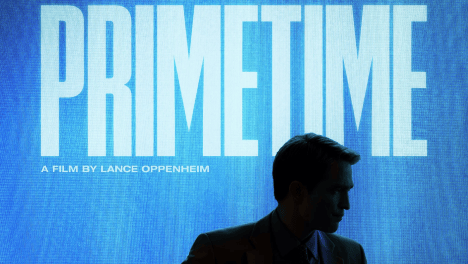
Primetime is a movie that is alluring in a way that is hard to explain. It is extremely surreal, and I left the theater wondering why I couldn’t shake the thought that Chris Hansen (Robert Pattinson) was displayed as more monster than man in this film. Nothing fantastical happens, yet the absurd theatrics of the cinematography are otherworldly. This movie is far more than just a biopic; it’s a possession of a movie, a modern retelling of Dracula puppeting the form of Chris Hansen’s story to mythologize his monstrous tendencies.
Dracula centers around the titular character leaving his decrepit castle in Transylvania and traveling to lively London with its people and their fresh blood. Dracula’s exodus from his known domain to London is the deciding detrimental factor for his downfall. Chris Hansen spends the majority of Primetime in ruin as well; his “estate,” “To Catch a Predator,” has dwindling views to go along with the potential airing of his affair, which provides pressure as he’s placed in primetime, forcing him to leave his isolation where he’s in complete control of his domain and depart to lure in more viewership. It’s clear Chris Hansen is confident in his sting, making grand entrances. Hansen first enters the film in a shot-for-shot recreation of Bela Lugosi “Dracula.” The first piece of music heard in the film is called Incantations by Ari Balouzian, and it is used to build on the otherworldly allure of Hansen’s character, making it feel as if you are being beguiled by a creature beyond our understanding.
In the Sting houses, Hansen resides for the majority of the movie; everything is meticulously controlled, and every person is working to fulfill his desires. This is the way in which Chris is comfortable, but much like Dracula’s lust for new blood, it is what inevitably lured him away from the safety of his castle. Hansen’s thirst for viewership drew him out of the safety of these sting houses, shown literally in the third act of the movie, with Hansen’s obsession with what they call the whale, a predator they believe to be a high-ranking government official. The issue is that the whale is outside of where production had planned the next shoot. Hansen’s impulsive decision to relocate the show in an attempt to catch the whale causes chaos for the entire crew. This chaos is only exacerbated when the Whale refuses to come to them, so they contact the police to escort them to the whale’s house so they can document his apprehension, only for, on their arrival, the whale’s Texas district attorney, Bill Conradt, to take his own life. While that sounds surreal, this actually did happen; the ensuing lawsuit for 105 million was the true downfall of “To Catch a Predator.”
Primetime holds even more parallels to Dracula; Renfield is Dracula’s disciple who schemes to further the vampires’ cause, and Van Erik is the lead man in this operation of perverted justice who lures the predators to these houses by chatting to them online. Dracula uses telepathic communication to speak to his victims in their dreams and bring them to him. Chris Hansen uses the dream world of the internet and chat sites to lure in the predators. Primetime uses many fanatics that Hansen intentionally empowers in order for them to serve his self-interests; he uses his colleagues’ aspirations against them, manipulating Andie (Merritt Wever) and Decoy Dan (Skyler Gisondo) to believe he knows what’s best by promising them the impossible so they will help him feed on the high he gets from virality. Decoy Dan is brought in for an audition where he believes he’s going to be acting on TV to help him get a credit for his SAG-AFTRA card, only for him to show up to his first day of filming to realize he was misled and what was actually happening; in the Dracula novel, Jonathan Harker travels to Dracula’s castle on what he believes to be business only to realize by all the strange occurrences that he was lured there under false pretenses. These overt parallels to Dracula serve to steep Chris Hansen in mythological tradition, portraying him as the modern vampire ready to suck the life from this new frontier that is the internet.
Just as the Dracula novel came at the dawn of the 20th century and used the vampire as a metaphor for the anxieties and cultural shocks of the late-Victorian Industrial Revolution, “To Catch a Predator” and Primetime, as a result, use Chris Hansen as the synecdoche for the post 9/11 media monsters that blur the lines between reality TV and journalism. Primetime shows how “To Catch a Predator” was the perfect intersection of interests and fears for the American public in the wake of 9/11. Using surveillance and partnering with law enforcement, it brought justice to what could be agreed upon as a true moral evil in sexual predators and publicly humiliated them for everyone’s entertainment. It gave people the serotonin rush of good prevailing over evil at a time when 71% of the American public reported depression and nearly 3 quarters (73%) feared subsequent attacks. It filled the void in a nation that was desperate for some tangible sense of control; the chaos overseas caused America to look inward at domestic threats. Chris Hansen says in the film that NBC wasn’t strong on the idea of “To Catch a Predator” and was only swayed by his pitch: “There’s a man on your porch with his dick in his hand, and he is going to stick it in your daughter. I’m gonna show you how to not let that happen.” This line of dialogue showcases that the success of the show was dependent upon the exploitation of these fears.
Chris Hansen views his action as an objectively righteous crusade, but when Decoy Dan was no longer willing to serve the advancement of this crusade and called Bill Conradt at the end of the film, Hansen gives him an ultimatum: “you’re either with me, or you’re with him.” Hansen embodies the black-and-white view Americans adopted; he views the predators as an ancient evil he needs to purge the world of. The backdrop of 9/11’s effect is even more apparent in the film’s own backdrop of Stone Phillips coverage on the war in Iraq, an obvious and significant part of the war on terror. It can briefly be seen that the Murphy Texas Police officers even have photos of Osama Bin Laden at their shooting range for target practice. One of the only instances of Hansen speaking to the public about his crusade takes place on a plane as an old man questions why he never just puts his hands on the predators, and Hansen responds that he thinks what he does is actually worse. Later in the film, he compares televisions being in every home to the way every town once had a pillory, paralleling his persecution of predators to a barbaric practice, and it is only ended after blood is shed.
Primetime forces the viewer to analyze the standards we have as a society by flipping Chris Hansen’s iconic catchphrase “What would have happened if I wasn’t here?” 9/11 opened the door for these sorts of media monsters to flourish. The ultra-surveillant vigilante justice was made to manipulate America’s thirst to bring the bad guys to justice and has ultimately led us to the panopticon surveillance state we exist in today with social media, Flock cameras, and Meta glasses. Everyone can agree that what predators do is heinous, but the effort to stop them becomes bastardized when it is intertwined with individuals’ self-interests. Dateline’s involvement got 23 of the cases tossed while one wasn’t even submitted. Bill Conradt’s suicide led to 24 other predators being acquitted for faulty police work. The new district attorney said in a statement to NBC: “The fact that somebody besides police officers was involved is what makes this case bad. “If professionals had been running the show, they would have done a much better job rather than being at the beck and call of outsiders.” The sensationalism of a serious issue became a sadistic practice of self-righteousness, parading itself as ethical journalism. Hansen serving as the representation for the bastardization of the values America was built upon contextualizes his shattering sense of self throughout the film as America’s as well. When he recites the iconic line at the end of the film, it serves as something completely horrifying.
OTHER THINGS I NOTICED
The shots in Primetime feel so claustrophobic with shallow depth of field. Every part of the movie is oversaturated; the color grading is magnificent, providing that Y2K television aesthetic. TikTok film critic Stephen Nothum was able to confirm through conversation with the designers that the two M’s in Primetime’s logo intentionally mirror the fangs of Dracula. Despite being shot in color, the use of extremely harsh highlights and shadows creates a dramatic effect very similar to a black-and-white film. Almost all daylight in the film is just seen as pure white light bleeding through blinds. There are multiple scenes in the third act where lightning strikes or the lights flare up, and it’s as if Chris Hansen teleports across the room. Throughout the film, everything Chris drinks is red, and the more people get close to him or are living dead in the same way as him, they slowly become filled with the red as well. Chris has a red tie; Decoy Dan has his red jacket and slowly becomes lit more in red as he falls down the path Hansen finds himself, until returning a bracelet Chris gave him and rejecting that lifestyle. Chris only eats fast food in the movie, representative of his desire for immediate satisfaction. Other examples of this need are shown by waking his children up from their sleep to show them a show that’s far too inappropriate for them, telling his wife he will recommit himself to her to fall at the slightest temptation, or even putting himself in ultimate danger by charging directly out to the whale with no real plan because he needed to cover up the story of his mistakes.
Taurean Jewett II is a third-year English major at Holy Family University. Their interests include poetry, fashion & music.
Work Cited
Primetime. Directed by Lance Oppenheim, A24, 2026.
Slavin, Michael. “Primetime’s Infamous “To Catch a Predator” Sting Led to a 0% Conviction Rate and 24 Predators Walked Free.” LADbible, ladbible, 29 Sept. 2026, www.ladbible.com/ entertainment/film/primetime-catch-predator-real-sting-murphy-texas-827746-20260928. Accessed 4 Oct. 2026.
Stephen Nothum. “Chris Hansen as the First Vampire of the Internet Age Makes Soooooo Much Sense. More Thoughts on This Elsewhere… #Primetimemovie.” TikTok, 1 Oct. 2026, www.tiktok.com/@authorstephennothum/video/7691818939759791391. Accessed 4 Oct. 2026.
The Associated Press. “DA Refuses to Prosecute ‘Catch a Predator’ Cases.” NBC News, 28 June 2007, www.nbcnews.com/id/wbna19486893. Accessed 4 Oct. 2026.
“To Catch a Predator.” NBC News. TV series.





Leave a comment