
By: Emily Lynch
The buzzer sounds and nerves shoot through her body. She is tense, hoping that she and her team can pull off today’s feat. She knows the risks: a concussion, a broken arm, a bloody nose, or worse: letting her teammates down. Heart pumping, she assumes her position, prepared for the most exhilarating yet exhausting competition she knows and loves.
Let me ask: if you had not read the title of this piece, what would you assume the sport being described was? Volleyball? Basketball? Maybe soccer, even? What I can almost guarantee is that you would not have thought of cheerleading. Maybe, that is because you may not even consider competitive cheerleading to be a “real sport,” much like the National Collegiate Athletic Association (NCAA).
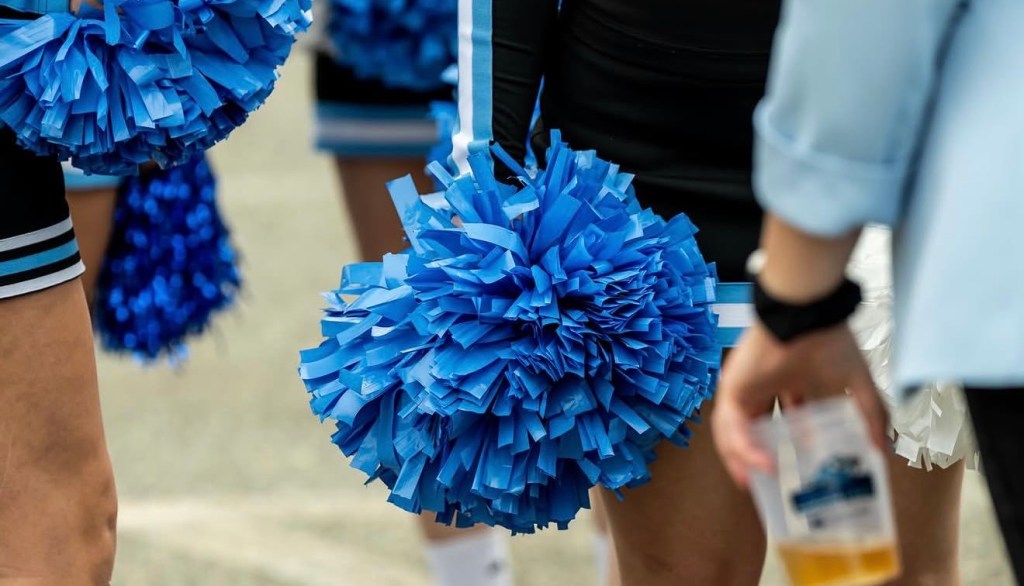
As a Holy Family University cheerleader, I know firsthand what it is like to be an outsider in the athletic world. Only since the 2025-2026 academic year has Holy Family Cheerleading transitioned from a student club to an official sports program at the university. Even with that change, Holy Family cheerleaders still do not receive the same inter-sports respect as other sports on campus. I believe that if the NCAA voted to recognize competitive cheerleading as a sport, all cheerleaders would be treated with the same respect as other student athletes on their respective campuses. The NCAA should make competitive cheerleading an official sport for the following reasons:
- Cheerleading demands the athleticism required of all competitive sports. Cheerleaders are expected to hoist grown women over their heads, toss them over ten feet in the air, and catch them with little bracing, all with a smile on their face. This requires great strength, focus, and determination. Cheerleaders must be willing to put their own safety as risk, whether it be the flyer dismounting from a three-high pyramid, the bases slamming their bodies on the mat to make sure their flyer does not hit the ground, or the backspot praying that the flyer’s foot does not stomp on their face. According to OmniCheer, two-thirds of catastrophic injuries (broken bones, concussions, spinal injuries, and even paralysis) are suffered by cheerleaders.
- Cheerleading satisfies the criteria established for a competitive sport. According to the Women’s Sports Foundation, a sport is defined as “a physical activity that involves propelling a mass through space or overcoming the resistance of mass, competing against/with an opponent, governed by rules that explicitly define the time, space, and purpose of the contest and the conditions under which a winner is declared, and the purpose of the competition is a comparison of the relative skills of the participants.” In the context of cheerleading, the “physical activity involving a propelled mass” is the act of putting up a stunt. Competitive cheerleaders engage in competition season from November through April each year, with the most anticipated competition being UCA’s All Star National Championship held in Disney World. Further, standardized scoring systems are used to evaluate the performance of the cheerleaders, with points earned by the objective difficulty of a given stunt, tumbling pass, pyramids, tosses, jumps, and overall synchronization.
- Cheerleading has already been recognized by athletic governing bodies as a legitimate sport. The International Olympic Committee (IOC) has already voted to grant full recognition to competitive cheerleading as an Olympic sport. Although cheerleading has yet to be selected as a sport to compete in the Olympic games, recognition as distinguished as an Olympic sport feels like a step in the right direction towards respect in the athletic realm. If the International Olympic Committee believes that cheerleaders belong in the Olympic Games, why does the NCAA hesitate to allow cheerleading as a collegiate sport?
What the NCAA does consider a sport, though, is STUNT. Essentially, STUNT is competitive cheerleading’s younger sister. According to USACheer.org, STUNT “removes the crowd-leading element and focuses on the technical and athletic components of cheer…These elements are put together in short routines that both teams must perform head-to-head on the floor at the same time. The team that executes the skills best wins the round and the point and has the opportunity to determine which of routine level will be called next.” Further, “USA Cheer created STUNT as an opportunity for colleges, universities and high schools to meet the strict Title IX requirements of a sport. With more than 500,000 high school cheerleaders, STUNT expands participation opportunities for young women by providing an avenue for female athletes to use their cheerleading background in a new format.”
The main reason that competitive cheerleading is not considered a sport under Title IX is because it has been ruled as an activity whose primary purpose is to “…support or promote other athletic activities.” This may be true for strictly sideline cheerleaders (those who stand on the home side of the basketball court or football field), however, teams that either do not participate in sideline cheerleading or do both sideline and competitive are lumped into this ruling, when they do in fact participate in interscholastic athletic competitions, such as the aforementioned UCA or NCA (National Cheerleader Association) national competitions. The theatrical nature of competitive cheerleading is criticized under this ruling as well. I would argue, though, that all athletes, no matter their sport, are giving some type of performance. After all, is not the whole purpose of spectating an athletic event to be entertained? And through said entertainment, for sports organizations to profit? Cheerleaders are a quintessential part of game-day culture helping to create a memorable experience for all in attendance.
If the performance myth can be debunked, then what is the core issue with competitive cheerleading as an NCAA recognized sport? Well, Grindstaff and West write, “If sport is an arena in which men express and sustain hegemonic masculinity, cheerleading is said to embody the qualities associated with ‘emphasized femininity.’” Cheerleaders are all too familiar with belittling commentary about wearing makeup, styling their hair, or the look of their uniforms, which is often used against them as a way to discredit their undeniable brute athleticism.
This begs the question: why does athleticism exist as the binary opposite of femininity? I cannot help but wonder if the main offense of competitive cheerleaders is that they present uncomfortably feminine consume sport media, thus they could not possibly be strong, skilled, and hard-working athletes. It is also worth noting that competitive cheerleaders are not required to wear makeup, have elaborate hairstyles, or wear revealing uniforms in order to compete. Yes, there are rules and regulations if athletes choose to present themselves in such a way for competition, however, there are no penalties if an athlete chooses to compete with a bare face and a ponytail.
To best support their female athletes, the NCAA should consider voting to make competitive cheerleading its own collegiate sport. Competitive collegiate cheerleaders do not wish to be placated with STUNT. We wish to do what we love and work so hard to do; just as hard as any other collegiate sports team. Cheerleaders risk severe physical injury and face public ridicule every time they step on the mat, all with a glowing smile. All we ask is for a seat at the table when it comes to college athletics.
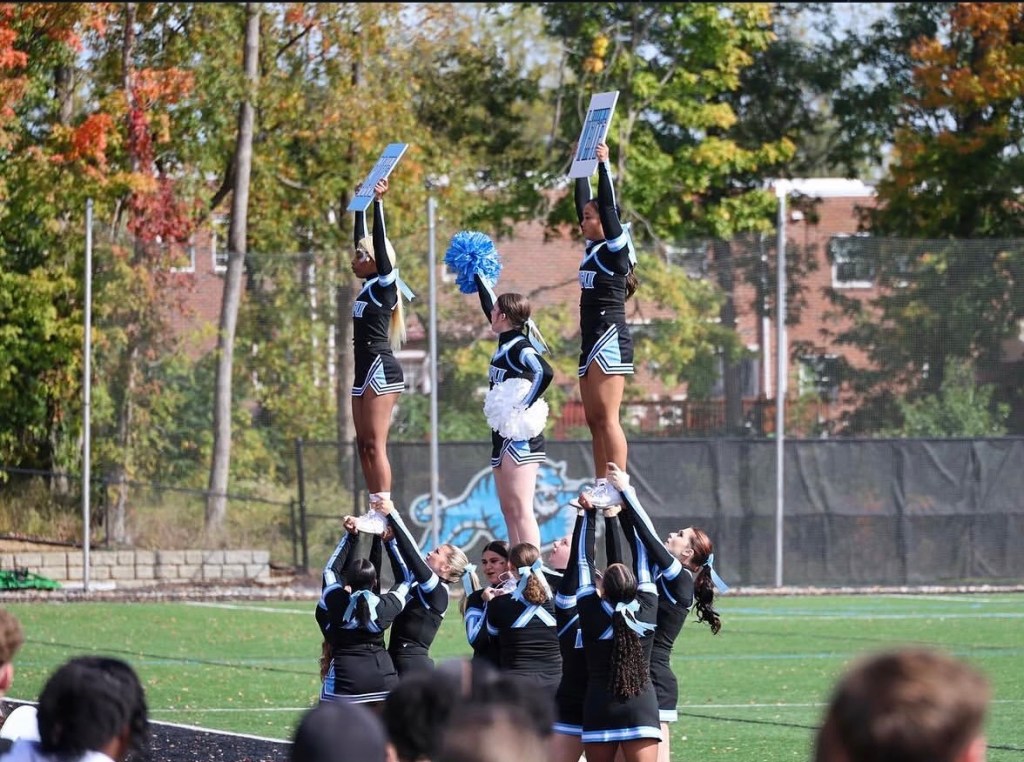
The pyramid stands tall and mighty in the center of the mat, bases strong and flyers tight. The stunt hits, and the spectators erupt in applause, judges smiling with approval. Her team wins the NCAA DII cheerleading championship, bringing honor to her school. She cannot wait to see the trophy glowing in the case, the championship banner hanging proudly in the gym for all to see. This is not now, and it may not be for a while, but, maybe someday, it could be this competitive cheerleader’s reality.
Emily Lynch is a Secondary Education-English major graduating in Fall 2027. She is on the cheerleading team, a Tiger Tutor, and a member of the Honors Program. In her spare time, Emily enjoys reading, listening to music, and thrifting.




Leave a Reply