
By: Lily Marchiafava
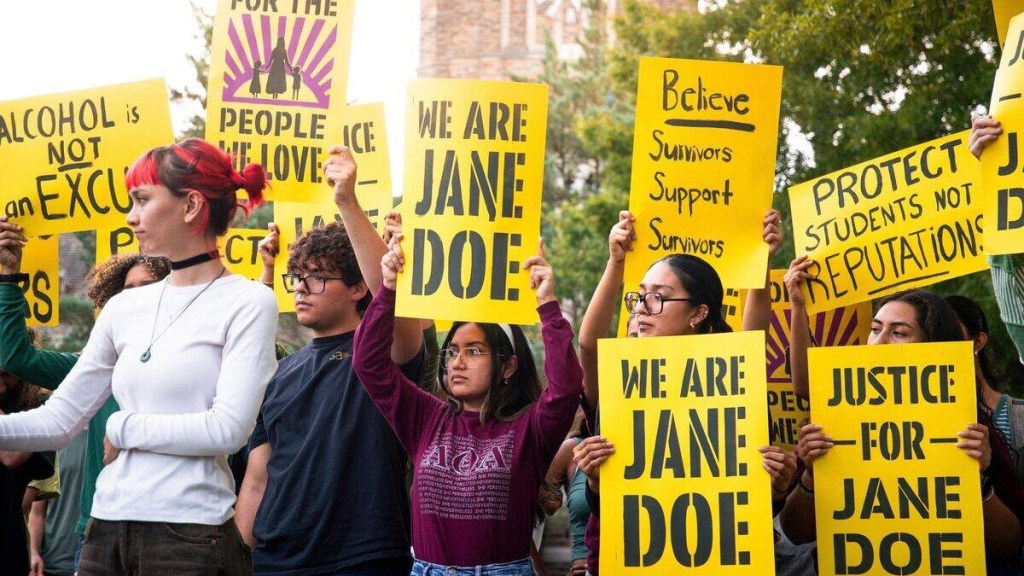
Image courtesy of:
The News Observer
Do this math: If one in four women experience sexual assault in her lifetime, but less than five percent of sexual assaults are reported to law enforcement, and of the cases that are reported, one in five are deemed baseless by police and coded as “unfounded” (Murphy-Oikonen et al., 2022), then tell me, how many women experience sexual assault in their lifetime?
The truth is, no figure or statistics can tell us the exact number. They do, however, tell us something else: the experiences of countless women will never appear in police records, and even among those who report, so many encounter a dismissive system. What we officially count is not even the full extent of what women experience.
Dismissing sexual violence has become an extremely common practice among police, but dismissal does not begin and end in a police station. That, would be a much smaller issue. Unfortunately, the dismissal of sexual violence and women’s experiences is a cultural problem. One that extends into our universities, our workplaces, our homes, group chats, and even our White House.
Recently, resurfaced allegations of sexual violence at Cornell University have brought this problem back into national conversation.
In October 2024, a young woman identified as Jane Doe alleged that she was drugged and sexually assaulted by members of the Chi Phi Fraternity. Cornell conducted an internal investigation, and prosecutors initially declined to bring criminal charges. In September 2026, Doe filed a civil lawsuit, and the criminal investigation was reopened amid growing public scrutiny. Legal proceedings for this case are ongoing.
Reports that some accused students were offered the opportunity to submit essays to mitigate their suspensions have provoked a very understandable outrage. An essay. A written reflection. A simple academic exercise. How do we live in a world that can reconcile the gravity of sexual violence with the idea that an essay could form a disciplinary response?
Cornell, of course, disputes that essays were the sole consequence, and that the university’s disciplinary process included more serious sanctions, but they don’t deny the essays as part of said process. But the outrage over the reported use of essays shows something about what people are starting to ask. Do institutions truly understand the harm sexual violence causes? Their responses clearly don’t reflect an understanding, but instead offer protection for the abusers.
The response to this case has extended far beyond the university’s disciplinary process. Cornell has appointed a second independent investigator, former federal prosecutor Sally Yates, to examine its handling of the allegations. Students have staged protests, and more than 60,000 alumni and supporters have pledged to withhold donations until the university meets demands for greater transparency and reform in sexual assault cases (Los Angeles Times, 2026). These actions reveal that the public is asking questions that extend beyond the guilt or innocence of the individuals accused. What responsibility do institutions have when allegations of sexual violence are brought to their attention? What does accountability look like when the institution itself is under scrutiny? And who gets to decide whether its response has been sufficient?
Sexual violence is not an essay assignment. It is not a public-relations problem to be managed. It is not an inconvenience to an institution’s reputation. The woman at the center of this case is still known to the public as Jane Doe. There has been speculation of her identity, but speculation it remains. Jane Doe is a name used to protect an identity, but one that can reflect a familiar identity. Across courtrooms, public discussions, and news reports, women who report sexual violence are often known to the real world through a pseudonym rather than their own names.
Jane Doe is everywhere. She remains hidden behind those two words while the public debates the credibility of her experience, dissects her decisions, asks what she was fucking wearing, and argues over what happened to her. Instead of just believing her.
She is not just Jane Doe. She is a person whose life continues after the headlines disappear from your feed. And Cornell is not the beginning or the end of this story.
More Than Cornell
This is about Epstein. It is about Larry Nassar. It is about powerful men and the institutions that have failed to protect the people who trusted them. It is about the ways status, money, influence, and reputation can shape the public’s response to allegations of sexual violence.
And it is about our own president.
On October 2, 2026, President Donald Trump spoke from experience in painting the accused as victims, as he stated the men accused in the Cornell case would not get a “fair shake” under New York Attorney General Letitia James, who was appointed to oversee the criminal investigation. (Ali, 2026). The significance of such remarks extends beyond the individuals involved in this particular case. When public attention shifts immediately toward the possibility that accused men will be treated unfairly, the person who reported sexual violence can once again become secondary to the reputations and futures of those accused. Concerns about due process are legitimate and necessary. But they should not prevent us from asking whether the person who came forward was protected, whether her allegations were investigated appropriately, and whether the institution responded in a way proportionate to the facts established. Fairness cannot be reserved for one side of a case.
Fairness matters. The accused are entitled to due process, and allegations must be evaluated through evidence and the law. But fairness cannot mean treating the possibility of consequences as an injustice in itself. Nor should fairness toward the accused eclipse empathy for the person who came forward. If we lack such empathy, how can we expect anyone to come forward?
We must be able to hold two principles at once: no one should be convicted without a fair process, and no survivor should be dismissed simply because her allegations are difficult, uncomfortable, or inconvenient to confront.
The Michigan Journal of Gender & Law offers a useful legal framework for examining this tension. In The Sexual Misconduct of Donald J. Trump, the author discusses the legal barriers surrounding sexual misconduct claims, including the difficulties of pursuing claims after statutes of limitations have expired and the legal questions raised when an accuser challenges public denials of her allegations. The discussion of Zervos v. Trump illustrates how a dispute over alleged sexual misconduct can become a legal battle over whether the accuser herself is telling the truth. (27 Mich. J. Gender & L. 81, 103–08 (2020).)
The significance is broader than any one defendant. There is a difference between a claim being legally actionable, an allegation being proven in court, and a person’s experience being taken seriously. These are not interchangeable standards. When public discussion collapses them into one, it becomes easier to treat a failure to prosecute as proof that nothing happened, or to treat a person who reports abuse as someone whose motives must be put on trial.
That is not accountability. It is another obstacle survivors must navigate.
The Culture We Build
Looking beyond Cornell; beyond the courtroom, beyond the powerful men whose names seem to repeatedly be synonymous with scandal.
Because this is also about the so-called small things.
It is about a man who speaks crudely about his wife when she is not in the room, while everyone around him laughs uncomfortably because nobody wants to be the person who makes it awkward.
It is about a boss who asks a woman when she plans to have a child so he can “plan around it.”
It is about the comments made about baby girls, that they will be “trouble” when they grow up. It is about boys’ group chats where jokes about harming women are dismissed as harmless because they are only jokes.
It is about the things we tell ourselves are not that serious. Not that important. Not worth confronting.
These moments are not equivalent to the topic of sexual violence. But what they are is examples of casual misogyny. They reveal and reinforce the attitudes through which women’s boundaries, autonomy, and dignity are treated as less important than men’s amusement, desires, or convenience.
Culture is not created exclusively by the people who commit the most extreme acts of violence. It is also shaped by the people who laugh, the people who stay silent, the people who excuse, and the people who decide that speaking up would be too uncomfortable for them.
We build that culture in these ordinary moments. We build it when a degrading comment passes without challenge. We build it when boys learn that cruelty toward women earns approval from their peers. We build it when a woman’s discomfort becomes the punchline rather than a reason to stop.
And we reinforce it when we demand that women prove, again and again, that their pain deserves our attention.
This is not to say that every person who laughs at an inappropriate joke will commit an act of sexual violence. It is to say that the attitudes we normalize shape the environments in which people learn what is acceptable, what will be challenged, and what they can get away with.
If we want to change the culture surrounding sexual violence, we cannot wait until the harm is so undeniable that it becomes national news.
We have to challenge the culture before that point, the same culture that teaches boys to dismiss degrading jokes as harmless can teach institutions to treat sexual violence as a problem of reputation rather than a question of responsibility. When misconduct becomes something to manage in silence, when consequences are treated as an inconvenience, or when protecting an institution’s standing takes precedence over examining how someone was harmed, the message is unmistakable. That some interests matter more than the person who came forward. This does not mean that every institutional failure has the same cause or that every allegation has the same outcome. It means that the standards we normalize in everyday life influence the environments in which serious allegations are received, investigated, and addressed.
Educate Our Sons
We often hear that we must protect our daughters. Teach them to be careful. Watch their drinks. Share their locations. Walk home together. Do not trust too quickly. Do not wear this. Do not go there. Do not put yourself in that situation.
Women learn these rules early. We learn to assess the room, watch the drink, calculate the walk home, and consider whether a man we call a friend is someone we can truly trust.
We learn to be afraid of the ordinary things like walking alone at night, having a drink, being friendly, being alone with someone we know.
And yet, how often do we put the same emphasis on teaching boys not to harm?
We should protect our daughters, absolutely. But we must also educate our sons.
Teach them consent as something more meaningful than the absence of a “no.” Teach them that intoxication can compromise someone’s ability to consent. Teach them that another person’s body is not a reward, an entitlement, or a source of entertainment. Teach them that consent can be withdrawn at any time. Teach them that masculinity does not require dominance, that rejection is not humiliation, and that a group of friends is not an excuse to abandon one’s conscience.
Teach them that the jokes they make about women matter. Teach them that what they say when no women are listening matters. Teach them to challenge their friends, even when doing so costs them social approval.
And teach them that being a good man is not simply about never being accused of doing something wrong. It is about actively respecting other people’s autonomy and refusing to participate in a culture that aims to diminish it.
A woman is somebody, not some body.
She is not a lesson for a university to learn after a scandal. She is not a liability. She is not a political talking point. She is not a problem to be managed, a credibility contest to be won, or an inconvenience to the people around her.
She is a person.
And that should never be a difficult concept to understand.

Keep It in Mind
The Cornell case is horrible. The allegations are deeply disturbing. They deserve serious scrutiny, a fair and thorough investigation, and an institutional response proportionate to the facts established. The woman who came forward deserves to be treated with dignity throughout that process.
But why does it take a story like this to make us talk about the normalization of sexual violence in our society?
Why must an allegation involving an elite Ivy League university become a national scandal before we ask what we are teaching our sons? Why must survivors’ experiences become headline news before we confront the ways our institutions respond to them? Why do we find it so easy to condemn the most visible examples of misogyny while overlooking the quieter moments in which disrespect is normalized?
Yes, post about Cornell. Talk about Cornell. Protest about Cornell. Demand transparency from institutions and accountability from those responsible for investigating allegations of sexual violence. Be fucking outraged.
But when the story leaves your feed, do not let it leave your mind.
Remember the women who never report, and how large that number really is. Remember those who report and are not believed, who never speak of it again after dismissal. Remember that an investigation ending without criminal charges is not proof that an allegation was false. Remember that due process and compassion are not mutually exclusive.
And remember that sexual violence does not begin and end with the most notorious names in the news. It exists in the everyday environments we create, in the attitudes we tolerate, and in the silences we choose.
Violence against women occurs every single day. Women know this not simply because they read the headlines, but because they live with the fear that shapes how they move through the world.
We cannot keep asking women to live defensively while asking so little of the culture around them. We cannot keep treating sexual violence as an isolated tragedy when the conditions that enable it are all around us. And we cannot claim to want change if our outrage lasts only as long as the story is trending.
The question is not simply what happened at Cornell. It is about how long we can uphold a society with no accountability and the prominent normalization of sexual violence.

Lily Marchiafava is a Senior English major with a minor focus in Creative Writing. She is an executive editor for Tri Lite, and President of Writers Bloc. Lily’s interests include literature, writing creatively, all things vintage, thrifting, and horror and romantic film. She plans to graduate in spring 2027.
Sources:
Bennett, Geoff, et al. “What the Cornell Case Reveals about How Sexual Assault Allegations Are Handled.” PBS, Public Broadcasting Service, 7 Oct. 2026, http://www.pbs.org/newshour/show/what-the-cornell-case-reveals-about-how-sexual-assault-allegations-are-handled.
“Commentary: To Trump, the Cornell Seven Are Victims. It’s a Familiar Refrain for Him.” Los Angeles Times, Los Angeles Times, 8 Oct. 2026, http://www.latimes.com/world-nation/story/2026-10-08/cornell-seven-wont-get-fair-shake-trump-says.
Murphy-Oikonen, Jodie, et al. “Unfounded Sexual Assault: Women’s Experiences of Not Being Believed by the Police.” Journal of Interpersonal Violence, U.S. National Library of Medicine, June 2022, pmc.ncbi.nlm.nih.gov/articles/PMC9136376/.
Robson, Ruthann. “Michigan Journal of Gender & Law Michigan Journal of Gender & Law Volume 27.” Repository.Law.Umich.Edu, 2020, repository.law.umich.edu/cgi/viewcontent.cgi?article=1274&context=mjgl.




Leave a Reply