
By: Ava Folcarelli
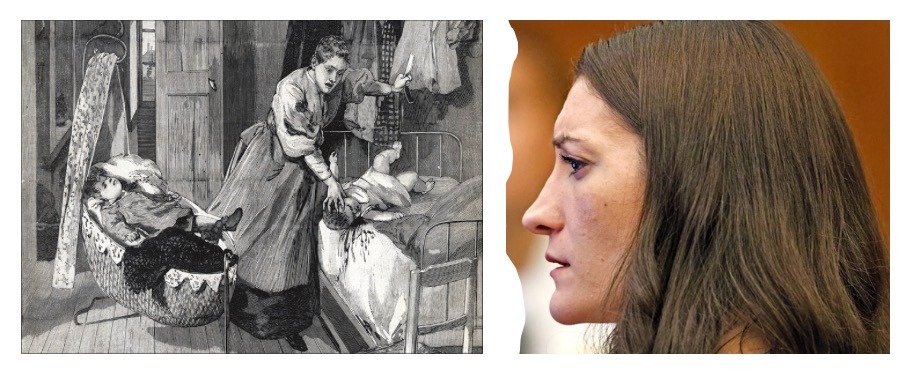
Just when you thought the talk about the Lindsay Clancy case had died down, I am here to express the coincidental connection this case has to a class I am currently enrolled in at Holy Family University. From being taught about women who were punished and viewed as insane, to living in a world where mental health services are not only accessible to those in need, but to women in need, I bring forth the question: exactly what excuse do we have for postpartum depression and anxiety to go untreated in this modern time?
The course is titled ‘Mad’ Women in the Archives; we explore women’s mental health diagnoses and behaviors through archived texts spanning the 18 and 1900’s. The course has a focus specifically on ‘mad’ women, as that is what women who experienced any sort of mental deformity were categorized as at the given time. We are asked to think critically about the psychological behaviors of women during this period and how the environment surrounding them impacted their actions and further treatment. A majority of our focus so far this semester has included puerperal insanity, infanticide, and sex in mind and education. Specifically, when connecting the Clancy case to the archived texts from centuries ago, it is interesting to notice the similarities that are still present despite the modern and innovative world we have become.
The facts of the Clancy case are as follows: In January of 2023, Lindsay Clancy was accused of murdering her three children with an additional attempt to commit suicide. Despite being known to express nothing but tender care and love towards her children, it was stated that in 2022 Clancy showed signs of mental disorders such as anxiety and depression. In addition to feeling suicidal, Clancy also stated that she heard voices in her head that prompted her to harm her children by means of “keeping them safe.” Before the tragedy, however, Clancy made attempts to check herself into a mental facility in December of 2022, but she was discharged on the same day of admission. It is also stated that she had an additional failed attempt to receive inpatient treatment at another hospital.
Diagnoses for postpartum mental disorders appeared as early as the 1800s, most recognizable back then as puerperal insanity. While treatment was available for Clancy, in the 21st century, the system still managed to fail her. In my course at HFU, I learned about Bucknill and Tuke, Victorian psychiatrists who co-wrote A Manual of Psychological Medicine. On the topic of puerperal insanity, they wrote, “the excitement resulting from the puerperal state is so important that it merits our special attention. It is a disorder which invades the sick chamber at a time when it is most acutely felt; nor is it a very rare occurrence” (Bucknill & Tuke, 235). These physicians not only emphasized the importance of treating and caring for patients with puerperal insanity, but also how common it is for a postpartum woman to experience these symptoms. This source alone brings me back to the question I posed earlier: exactly what excuse do we have for postpartum depression and anxiety going untreated in this modern time?
While we do not have the exact reasoning for Clancy’s mental treatment being denied on multiple accounts, there is evidence of the misdiagnoses she did receive. There is also evidence from a phone call between Clancy and a suicide hotline, where the clinician who evaluated her stated, “she did not meet the criteria for inpatient treatment due to not having any suicidal ideation plan.” This call took place just over a month before the tragedy. On top of not being given the extensive care she was due for, there is evidence that Clancy was being handed out drugs like they were candy. From multiple providers, Clancy was prescribed the following: Ativan, Remeron, Klonopin, Ambien, Seroquel, Valium, Lamictal, Trazodone, and Amitriptyline. Clancy was paid attention to in ways many women in the 18 and 1900s were not; yet still, her postpartum got the best of her and her children, because the “care” she was given was careless and disorganized.

It was not uncommon for women to murder their children back then. I have read archival pieces of infanticide where “the child’s arm was broke and its skull too; and as to the Face it had none; no Eyes nor Nose” (Jane Cooper, 1736). In other texts, the women claim not to know of their pregnancy or where they claim to have had a stillborn, and therefore they left the child stranded to die. Almost all of these women were punished harshly, death in most cases, for their actions; they were never given the chance to seek mental care. The difference, of course, between these cases and Lindsay Clancy’s case is that help was not offered nor available to these women. And, arguably, if the women back then were offered help from physicians such as Bucknill and Tuke, the understanding of postpartum depression and anxiety was not to the same extent as it is today and most likely would not have been as successful.

In a world where we have access to modern medicine and archives helpful in guiding our practice, there is no reason the mental health system should have failed Clancy. Unfortunately, the media has turned Clancy’s case into a blame game, with a hyperfocus on whether or not she should be punished for her actions. It is more important, however, that we recognize why the tragedy occurred in the first place. There is absolutely no reason for us to be going back in time when we have all of the resources we need and more in this very moment. The mental health system fails, and Lindsay Clancy’s children are the victims of their murder.
Ava Folcarelli is a senior English major with a minor in Creative Writing at Holy Family University. She is also studying to earn her Master’s in Education. Ava has a growing love for reading and a strong passion for writing. She primarily enjoys poetry writing and/ or any form of nonfiction writing.
Sources
Britannica Editors. “Infanticide.” Encyclopedia Britannica, 29 Sep. 2026, https://www.britannica.com/topic/infanticide. Accessed 7 October 2026.
Bucknill, J. C., & Tuke, D. H. (1858). A Manual of Psychological Medicine. Blanchard and Lea. https://archive.org/details/b21270843/page/n5/mode/2up
Charness, M. (2026, September 16). The Lindsay Clancy Case: Examining Postpartum Psychosis. Psychology Today. Retrieved October 7, 2026, from https://www.psychologytoday.com/us/blog/intersecting-law-and-mental-health/202609/the-lindsay-clancy-case-examining-postpartum
Harding, W. (1903). Puerperal insanity. In W. Harding, Mental nursing (pp. 65–91). The Scientific Press. https://doi.org/10.1037/12430-006
Old Bailey Proceedings Online (www.oldbaileyonline.org, version 9.0) December 1736. Trial of Jane Cooper (t17361208-10). Available at: https://www.oldbaileyonline.org/record/t17361208-10?text=t17361208-10 (Accessed: 7th October 2026).
Silva, D. (2026, August 29). How Lindsay Clancy sought help before she killed her three children. NBC Boston. Retrieved October 7, 2026, from https://www.nbcboston.com/news/national-international/how-lindsay-clancy-sought-help-before-she-killed-her-three-children/4006003/





Leave a Reply