
By: Ava Folcarelli
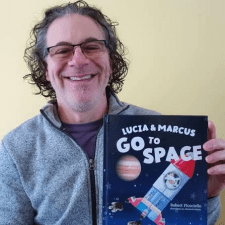
As a potentially aspiring author myself, I, a third-year English student at Holy Family University, sat down with my professor, Dr. Robert Ficociello, to inquire about his recent experience in becoming a published children’s book author. Commonly referred to as Dr. Fic, earlier this year, on January 31st, he had his first children’s book published: Lucia and Marcus Go to Space: JUPITER. Featuring his two children as the prime source of inspiration, the book follows the story of Lucia, the curious leader, and Marcus, her companion, as they travel to Jupiter. With larger themes of motivation towards exploring young ones’ curiosities and imaginations, I had the pleasure of interviewing Dr. Fic about his process of capturing these ideas. Alongside the ideas of his novel, I also inquired about his publishing process and experience, to offer insight to those like me, who might be interested in having a work of their own published one day.
Ava Folcarelli: For the reader, can you just briefly provide information about your career and your background, kind of like what teaching year you’re in, your staff position, and what clubs you advise, etc?
Dr. Fic: I’ll start with the easy stuff, which is a full professor of English, and I have advised 3 clubs: Tri-Lite, the Film Club, and Writers’ Bloc. And as far as background, my undergraduate degree is in marine biology, which I got a long time ago at one of the UMass campuses. I had probably a decade-long career in the sciences: everything from digging clams to getting EPA samples, and harvesting horseshoe crabs. But I ended up working as an analytical chemist in a lab–it’s sort of not what I got into biology about. You know, I wanted to be outside with fish and enjoying the environment, and then for about 7 of those years, I was just at an instrument, putting little sample files in and doing reports and that kind of thing. And then I wrote a book. It really sparked me to want to travel most of all, but also to write about those travels. I had been living in Florida at one point at a lab, and one of my friends dragged me to a psychic–believe it or not. The psychic said, “You know, if you get an idea for a story, it’s going to be successful, and you need to follow it.” So it was really a book, and I hate to be such a cliché about it, but I started writing a novel about an experience. And so I took a course, a literary theory course at Harvard, in the evenings, and I loved it. It was just like all the things that you think about. What is the purpose of language? How does meaning come across? And it was all these like big literary philosophical issues. And I just was like in love and loved it. And then I applied to some MFA programs. I got into the University of New Orleans, flew down, and loved the city. I had such a blast. I was already in my 30s, so I was ready to sort of live another completely different life. I loved it. I took a pedagogy course to be a TA and teacher…and I loved that too. I love teaching because it was part of your assistantship, and then I applied to PhD programs, and I got into Sumi Albany…met with the chair of the department, signed on the dotted line, and that was it. So that’s how I kind of got to where I am now.
Ava: So you already have 2 academic books, making your most recently published work the children’s book: Lucia and Marcus Go to Space: JUPITER. So, how did you come about your storytelling style? Because you’re saying you’ve written academic books before, but not like a children’s book or an illustration book either? So, did you have any authors you looked toward for inspiration, or was this solely produced in your own niche writing style?
Dr. Fic: During COVID, when everyone was stuck home, you know, I built the fire pit, and we’d sit around the fire, and we’d look at the sky, and the kids started asking questions, and I didn’t have all the answers, even though I had a science background. So I started researching it. And then one night, I came in and told my wife, “Yeah, I could write a children’s book about this.” And she’s like, “Okay, honey,” you know, you’ve had too many Bourbons to go to bed. And the idea kept kind of clawing at me. And at one point, every night we would read to our kids…and so we would go to the library and get 5 or 10 books at a time for each of them. So my research was like reading to my kids and establishing the types of books they liked and disliked. That’s kind of how the process went in terms of the inspiration, just like, you know, you just get an idea and you kind of mold it around, and then finally, it starts to be something. I didn’t really look to any authors for inspiration in particular. It was more like research on what the parameters of the genre were, you know, what I mean? It has to be 1000 words, it has to be 32 pages, you have to explain what level the writing is at…so it was more like researching that.
Ava: So then, I’ll ask, what was the writing process like? How long would you ballpark it took you to produce this work from idea to manuscript?
Dr. Fic: I’d say it was almost 2 years. I mean, it wasn’t like (I was) grinding away every day at the thing. It was more like, okay, I’m gonna pick this up again and read it and print it out, have my kids read it… I gave a copy to Dr. Rampelli, who had a version of it at one point. And then finally having edits that I felt worked to send out to agents and publishers.
Ava: Could you share your outlining process? I know you said it took 2 years, so were these ideas that you composed all on a Google Doc, or did some of them come to you in the kitchen, where you were writing ideas on a napkin?
Dr. Fic: Yeah, I would say I always try to keep a pen or some paper with me, especially if I’m working on a project. I started writing the storyline out: this is what happens, this would be a funny scene, and then kind of broke it down into pages. And as you know, you kind of already internalize story arcs–you know what I mean? The beginning, middle, and end. So, in that sense, I didn’t really feel a real need to kind of bark the story in outline form anyway.
Ava: So, at any point in your writing process, did you find yourself having writer’s block, or you weren’t really concerned with finishing it by a deadline?
Dr. Fic: No, I didn’t have writer’s block. I generally don’t believe in writer’s block. There have been a few authors who have said, and you’ll read this advice too, that you just have to block the time out and write. If you wait for great ideas to hit you, they will already be passed over, essentially. So that’s the grindy part of it, but I enjoy it so much that I don’t really find the grind of it. And one of the tips that I got at one point was when you’re writing, leave it in a place where you know you can start up again. I had to kind of leave it alone for a little while, letting it simmer and come back to it with different eyes.
Ava: So, did you have any difficulties with writing the book? Like, is there a certain part that was the most difficult or none at all?
Dr. Fic: I think like most editing, like you put something down there and then you’re forced to sort of delete it off the page. A 1000 words is not a lot of words, right? So that was probably one of the hardest parts. It’s like remembering this is a 4 or 5-year-old that’s going to be read to, or on the upper end, a 7-year-old who will be able to read it, and what is their ability to kind of know the difference between 1st person point of view or 3rd point of view or something like that. So I think that was the most difficult part, I have to get into the mind of someone that young and stay at that discursive level. But on the other hand, the other advice I got was, like, you’re writing to the parents as well. The kids aren’t going to be going in their diapers and pulling out money to buy your book; the parents are going to go there, and they’re going to read it, and they’re going to say, “You know, Sally, what do you think of this?” “Oh, I love Jupiter. I was reading about it in school.” And, okay, there it is. But especially with read-alouds, there are jokes in there for parents. So there’s really recognizing there’s 2 different audiences for it, I think that was kind of one of the things I really learned.
Ava: And to just switch gears from the writing process to the actual publishing and marketing, could you describe the process of actually finding a publisher, and then how you knew you made the right choice?
Dr. Fic: I queried agents, I queried publishers–those were my approach to it. Most of the responses I got were from hybrid publishers, which is what I ended up doing anyway. But as I went to different hybrid publishers, the prices were different. And this was kind of expensive, but I ended up applying for a grant and got the grant. So you’re like a co-investor with them. So the publisher is using your money, but they’re going to make money too.
Ava: Did you ever consider self-publishing?
Dr. Fic: I didn’t. It’s hard to publish short story collections; I’ve been trying, but in terms of a children’s book, there are some out there that have been successful. I think there’s a model that you could follow. But to be absolutely blatant, my job will not allow me to self-publish for it to count as a professional activity. You know, so that’s the part that tips it for you to be more of a professional. So I have to lean into my job, you know, so that was the only way I really could go with that.
Ava: And so you talk a lot about social media marketing. Is there any advice you can offer about successfully marketing your book, especially because it’s a children’s book, so it’s harder to find the demographic?
Dr. Fic: Well, your demographic is moms who are 25 to 35. And I, I just researched the hell out of it, like what kind of reels is this demographic watching? And when I started scrolling through Instagram and TikTok, for one, most children’s book authors are women. So, I try to use that to my advantage, you know, it was ‘hashtag girl dad,’ ‘hashtag author life,’ and those kinds of things. But the good thing is, I had to build my brand up from the very bottom, you know, from the 1st reel up through by 6th reel, learning like how often to put these out. Fridays are good for families, Mondays are good for moms who send their kids off to school, and they can re-scroll. That was the main thing: what does your real or post tell people to do or want people to do? The obvious one is to buy a book, and others, traffic to your website. So to me, I think of the brand you want to create. And one podcast was like, “You’ve got to know your why.” Like, why am I writing this children’s book? Why do I want to publish this? And also, it’s in the brand as to why you’re doing it. I do this because I love thinking about literature and how it affects my identity, and this demographic. So that was kind of the main thing, and it really crystallized that for me. I was like, yeah, why am I doing this? Obviously, I want to make money and sell this book. But, you know, to get people to do that, you have to tell them, like, this is about my kids. I’m doing this because my daughter felt intimidated when she went to school. She didn’t want to raise her hand because the class was mostly boys. But it was like, “Oh, yeah, Lucia knows the answer.” You know, and then she’d be like, “I don’t want to be singled out for something,” you know, whereas it should be, “yes, I know the answer!” But to me, it was like, yeah, I want to show this little leader who says, “Okay, we’re going. This is what we’re doing. Follow me.” And not be ashamed about it or not feel embarrassed about it, or anything like that.
Ava: And lastly, in terms of being a successful author, is there any larger advice you could offer to those aspiring authors out there, especially those who don’t know where to start?
Dr. Fic: I hate to say the obvious, but read in the thing that you want to publish in. A comparable piece of advice would be to research that genre, and think of the branding that you’re going to need to do because, as I know, and you know, it counts. I wouldn’t say fake it till you make it, but sort of it is that, except you’re not faking it, you’re making it till you make it. Just think that in terms of thinking, really think big picture about it. And take classes you’re interested in as well, you know, not the ones that just fit into your schedule necessarily. Join a writer’s group. I went to that, and I got some really good feedback, some encouraging feedback…
Ava Folcarelli is a Junior at Holy Family University, majoring in English. Her studies primarily focus on critical analysis and mastering the practice of editing. She is the co-executive editor and Vice President of Tri-Lite, the university’s newspaper, as well as the Vice President of Writers’ Bloc, the university’s writing club. She plans to graduate in the spring of 2027.


Leave a comment