
By: Lily Marchiafava
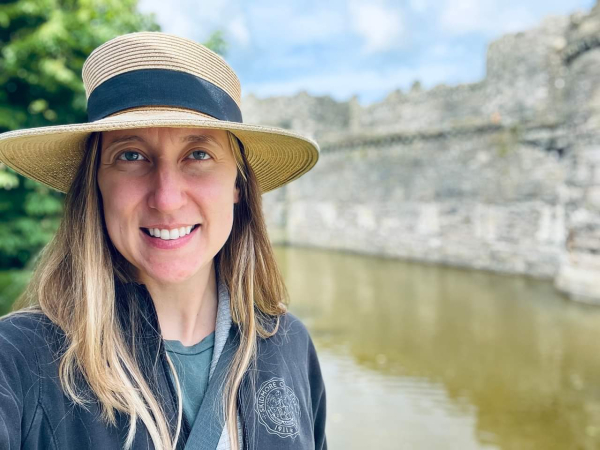
For Associate Professor of English Melissa Rampelli, literature is more than words on a page, but something to be experienced. Over her eight years at HFU, Dr. Rampelli has combined her passion for British literature with international travel, creating immersive study abroad opportunities that allow students to engage with history, culture, and learning in a completely new way. As an English major at HFU myself, with a yearning to travel, I sat down with Dr. Rampelli to discuss her experience with studying abroad, and really, to live vicariously through her words.
Dr. Rampelli’s passion for global learning began with her own travels in 2008, when she started exploring the real-world settings of the texts she teaches.
How did you first get involved with international education?
“I’ve been fashioning my own travel around literature and authors since I first started travelling internationally in 2008. I recently returned from Romania, where I reread the opening scenes from Dracula and visited towns and historical sites that inspired the novel. As a British literature scholar, I’ve also sought out novels’ settings and authors’ homes across England to bring the literature alive.”
She explains that reading literature on location reveals details that might otherwise go unnoticed.
“Reading passages from novels on site calls into relief subtle details a reader unfamiliar with the setting would miss. When you’re walking the streets, class differences become obvious through the homes, the layout, and the environment. Rereading on site reveals an almost secret layer.”
Although Rampelli didn’t study abroad as an undergraduate, her own experiences made her realize its value almost immediately.
What inspired you to start leading study abroad trips?
“I did not study abroad as an undergraduate, but I saw the benefit of it immediately and wanted to share this with students.”
Since then, she has led students across the British Isles and throughout Italy, carefully choosing destinations that balance excitement with familiarity.
What does a typical day abroad look like?
“Jam-packed! It’s a hands-on approach where the city or town is the classroom. In Dublin, we might start with an Irish breakfast and a walking tour, visit Trinity College, and end with a family-style dinner and live music. The days are long but rich.”
Beyond academics, these experiences encourage personal growth as students navigate unfamiliar environments and cultures.
How do these experiences impact students?
“Academically, students encounter ideas in new ways. Standing in a cathedral, seeing art in situ, walking the squares. Personally, they grow in confidence very quickly. By the end, most realize it was more accessible than they imagined.”
Dr. Rampelli intentionally creates opportunities for students to build independence during the trip.
How do you encourage students to step outside their comfort zones?
“We start with short pockets of free time and build up to an entire free day where students navigate on their own. At first, they’re nervous, but then the group chat fills with photos from their adventures, and the confidence building is incredible.”
Of course, travel comes with its challenges. From logistics to moments of uncertainty, these challenges often become the most meaningful learning experiences.
How do you handle unexpected barriers?
“It comes down to patience, grace, and community. We were once left outside Rome late at night and had to get 65 people back to the city. How a group comes together to problem-solve in those moments is incredibly character-revealing and character-building.”
For Dr. Rampelli, it’s often these unplanned moments that leave the biggest impact.
What have you learned from taking students abroad?
“So much of learning happens in unplanned moments. Growth often happens in mistakes, confusion, or small discoveries, not just the planned highlights.”
Students also come away with a deeper understanding of cultural differences and daily life abroad.
“They notice the different pace of life immediately. In Italy, meals linger, and people gather socially. They also see how history is layered into everyday life. You might grab an espresso and catch a bus surrounded by ancient ruins.”
For students who feel hesitant about studying abroad, Dr. Rampelli offers reassurance.
What would you say to a nervous student?
“It is natural to be nervous. That nervousness is usually the threshold of growth. And you won’t be navigating any of this alone. Once students realize they’re experiencing it together, that uncertainty quickly turns into excitement.”
As global connections continue to shape modern society, Dr. Rampelli believes these experiences are more important than ever.
Why is studying abroad important today?“There is really no substitute for interacting with people from different cultures. It expands not only what students know about the world but also how they see their place within it. It fosters empathy, curiosity, and openness.”
Through her work, Dr. Rampelli continues to show students that learning doesn’t just happen in the classroom; it happens in the streets, in conversations, and in the moments that push them beyond what may feel comfortable.
Lily Marchiafava is a third year English Student. She is President of Writers’ Bloc, Tri-Lite, and is on the Folio team. Lily’s interests include literature, creative writing, fashion, music, and thrifting.





Leave a Reply